
A large office clear-out can create far more electronic waste than expected. Before arranging electronic waste pickup free of charge, businesses need to identify what is being removed, protect information stored on devices, separate equipment correctly and prepare the paperwork needed for responsible disposal.
Computers, laptops, monitors, printers, phones, servers, keyboards, networking equipment and other electrical items can all require careful handling. The right preparation makes collection faster and reduces the risk of data loss, damaged equipment or compliance problems.
Office WEEE can include almost any unwanted equipment that depends on electricity or batteries to operate. Typical clear-outs involve desktop computers, laptops, monitors, printers, scanners, telephones, servers, routers, switches, cables, chargers and other peripherals.
However, not every item should automatically be treated in exactly the same way. The Environment Agency says businesses must classify waste before it is collected, recovered or disposed of because classification determines whether hazardous controls apply. Some electrical equipment can contain hazardous substances or persistent organic pollutants.
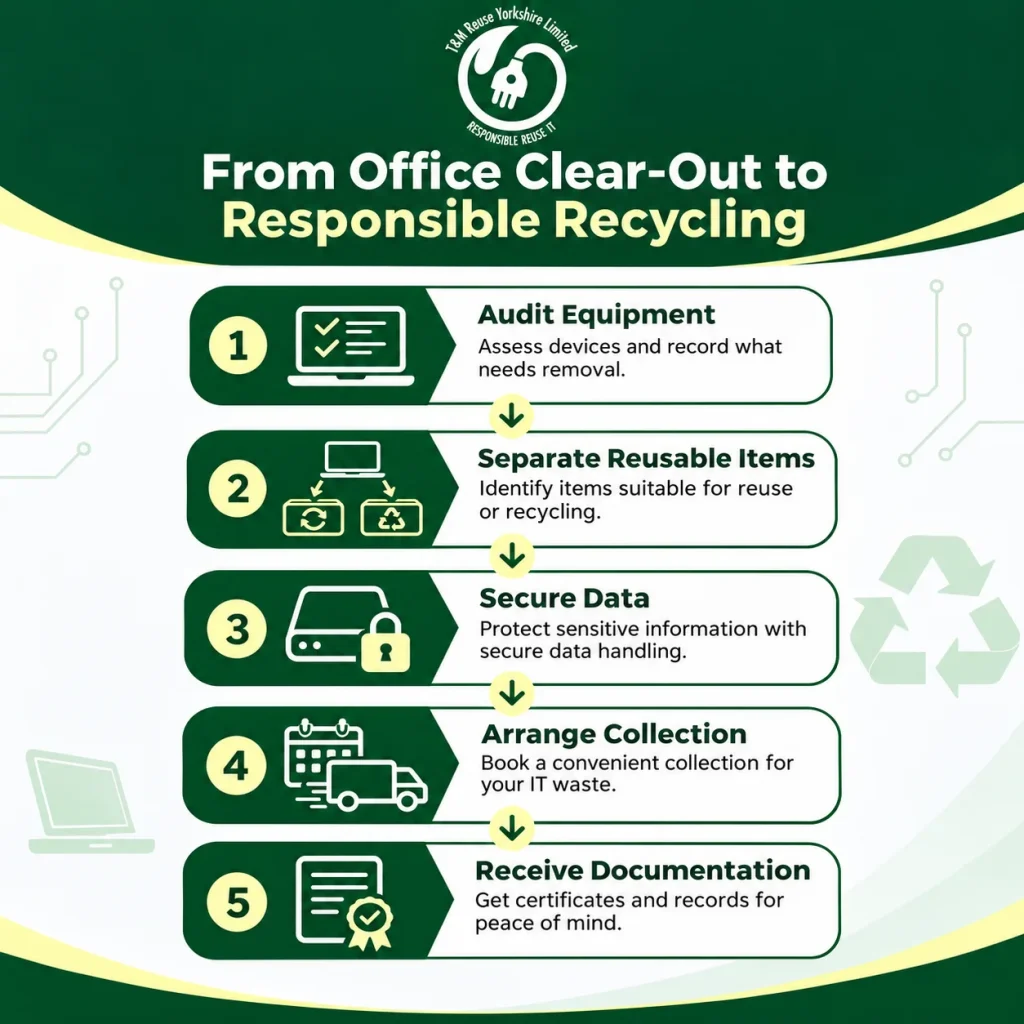
The easiest way to prepare for electronic waste pickup free is to create a simple equipment inventory before the collection date.
Record the equipment type, approximate quantity, location and condition. For computers, laptops, phones and servers, record serial numbers where practical. This gives your IT team a clear asset trail and allows the recycling provider to understand the size and nature of the collection before arrival.
Separate equipment that may still have a useful life from items that are genuinely waste. UK guidance recognises that equipment intended for reuse can remain EEE rather than becoming WEEE when specific conditions are met, including appropriate handling and protection from damage.
Do not throw working laptops or computers into a mixed waste pile simply because they are being replaced. A device that can be reused or refurbished may retain financial and environmental value.
Label reusable equipment separately and protect it from knocks, moisture and unnecessary damage. This is particularly important if equipment will be assessed for refurbishment rather than immediately dismantled.
Data security is one of the biggest concerns during an office equipment clear-out.
Deleting files, emptying the recycle bin or performing a basic factory reset should not automatically be treated as sufficient protection for every device. The NCSC recommends appropriate sanitisation before equipment or removable media containing important data is reused or disposed of.
Before electronic waste pickup is free, identify every device that may contain business, customer, employee or financial information. Coordinate with your IT team to determine whether data should be securely erased, the storage media physically destroyed, or another approved sanitisation process used.
Keep a record of the devices processed and request appropriate evidence from the disposal provider. A documented trail can make it much easier to demonstrate what happened to retired equipment.
Searching for electronic waste pickup free can produce very different service offers. Businesses should check what “free” actually covers before booking.
Some providers may offer no-cost collection when the volume or type of equipment makes the service commercially viable. Others may charge for particular difficult-to-process items, transport conditions or low-volume collections.
For example, T&M Reuse Yorkshire Limited currently advertises nationwide free IT disposal collections, while stating that cracked or visibly broken screens and CRT monitors or televisions may incur a charge. Its collection process asks customers to list equipment in advance so the collection can be assessed.
That makes the equipment inventory particularly useful. It lets you confirm eligibility instead of assuming every item will automatically qualify for electronic waste pickup free.
Before booking | What to check |
Equipment | Exactly what items are accepted |
Quantity | Minimum or qualifying collection volume |
Condition | Whether damaged items carry additional charges |
Location | Access, loading areas and collection floors |
Data | Whether secure erasure or destruction is available |
Documentation | Waste transfer and recycling records provided |
A common misconception is that every business can simply hand electrical waste to any collector. In England, businesses have a wider waste duty of care: waste should be minimised, stored safely, transferred to an authorised person and accompanied by appropriate documentation.
For non-hazardous waste, a waste transfer note is normally required when waste leaves business premises, and copies should be retained for two years. Hazardous waste can require different documentation and controls.
It is also worth checking that the organisation collecting the equipment is properly authorised. The Environment Agency provides a public register for waste carriers, brokers and dealers.

The phrase free WEEE waste collection should therefore never be interpreted as “no compliance responsibilities.” Free collection affects the commercial arrangement; it does not remove the business’s duty to manage waste responsibly.
Once electronic waste pickup free has been confirmed, make the physical collection straightforward.
Bring equipment together in a secure, clearly identified area where possible. Disconnect cables carefully and keep loose accessories together. Do not stack heavy equipment where it could fall or create a safety hazard.
Make sure loading routes, lifts, doors and parking arrangements are accessible. For a large clear-out, nominate one employee to coordinate the collection and confirm which equipment is leaving the premises.
Avoid mixing electronic equipment with general rubbish. Keeping WEEE separate supports proper handling and makes it easier for the collector to identify different waste streams.
One frequent mistake is waiting until collection day to discover that some equipment contains sensitive data. Another is failing to check whether damaged screens, specialist equipment or unusual electrical items are included in the quoted service.
Businesses also sometimes focus only on getting the equipment removed and forget about documentation. Keep copies of relevant transfer notes, certificates and asset records according to your internal retention requirements.
Finally, do not assume the cheapest-looking option is automatically the simplest. A properly planned electronic waste pickup free service should give you clarity about accepted equipment, collection arrangements, data handling and the paperwork you will receive.
A successful office electronics clear-out starts before the collection vehicle arrives. Audit the equipment, separate reusable items, secure data, confirm what qualifies for electronic waste pickup free, prepare the access route and verify the documentation process.
T&M Reuse Yorkshire Limited provides free IT disposal collection and states that its service includes processing with certification of disposal and data destruction for qualifying collections.
If your office is preparing for a major equipment replacement or relocation, why not start with an equipment inventory today and ask what could be collected, reused or securely recycled?
Electronic waste pickup is the collection of unwanted electrical and electronic equipment from a home, office or business premises for reuse, recycling or appropriate treatment. Business WEEE should be managed through an authorised waste route.
Some specialist recycling providers offer free collection for qualifying business equipment and volumes. Always confirm accepted equipment, minimum quantities and any charges for excluded or damaged items before booking.
Common examples include computers, laptops, monitors, printers, phones, servers, networking equipment, keyboards, cables and chargers. The exact acceptance policy depends on the collection provider and the type and condition of the equipment.
Businesses should ensure information is appropriately sanitised before equipment containing sensitive data is reused or disposed of. The NCSC recommends suitable sanitisation of devices, equipment and removable media containing important data.
A factory reset should not automatically be assumed to provide the level of sanitisation required for every business situation. The appropriate method depends on the device, storage technology, information involved and your organisation’s security requirements.
For non-hazardous business waste in England, a waste transfer note or equivalent documentation is normally required when waste is transferred. Hazardous waste can require a consignment note and additional controls.
Not always. UK guidance distinguishes business-to-business and business-to-consumer WEEE using factors such as product design, specification and intended use.
Yes, where equipment remains suitable for lawful reuse and is handled appropriately. Keeping reusable equipment separate from genuine waste can help preserve its value and reduce unnecessary material processing.
No. Electrical waste should be kept separate so it can be correctly classified, handled and processed. Some WEEE can contain hazardous substances, making appropriate separation particularly important.
Start with an inventory of equipment, identify data-bearing devices, separate reusable equipment, check collection eligibility and prepare the required access and paperwork. Confirm the collection arrangements with the provider before the scheduled date.